
Uncertainty Propagation in Ordinary Differential Equations
Differential equations are commonly used in science to describe many aspects of the physical world, ranging from dynamical systems and curves in space to complex multi-physics phenomena.
As an example, consider a simple non-linear ordinary differential equation:
Which describes behavior of a predator-pray models in continuous times:
x is the population of prey (sheep),
y is the population of predator (wolfes)
derivatives represent instantaneous growth rates of the populations
is the time and are parameters.
Can be written in vector arguments
with arbitrary function
The first steps we may want to do with an ODE is to see it's evolution in time. The most simple approach is to discretize the time axis into steps:
Replacing derivatives by differences:
we can derive a general scheme (Euler solution):
which can be written genericaly in julia :
function f(x,θ)
  α,β,γ,δ = θ
  x1,x2=x
   dx1 = α*x1 - β*x1*x2
   dx2 = δ*x1*x2 - γ*x2
  [dx1,dx2]
end

function solve(f,x0::AbstractVector,θ,dt,N)
  X = hcat([zero(x0) for i=1:N]...)
  X[:,1]=x0
  for t=1:N-1
     X[:,t+1]=X[:,t]+dt*f(X[:,t],θ)
  end
  X
end
Is simple and working (with sufficienty small
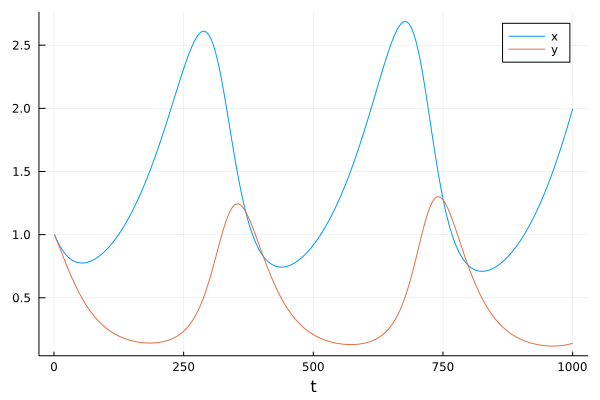
ODE of this kind is an example of a "complex" simulation code that we may want to use, interact with, modify or incorporate into a more complex scheme.
we will test how to re-define the elementary operations using custom types, automatic differentiation and automatic code generation
we will redefine the plotting operation to display the new type correctly
we will use composition to incorporate the ODE into a more complex solver
Uncertainty propagation
Prediction of the ODE model is valid only if all parameters and all initial conditions are accurate. This is almost never the case. While the number of sheep can be known, the number of wolfes in a forest is more uncertain. The same model holds for predator-prey in insects where the number of individuals can be only estimated.
Uncertain initial conditions:
number of predators and prey given by a probability distribution
interval
corresponds to uniform distribution gaussian
, with mean and standard deviation e.g. more complicated distributions are more realistic (the number of animals is not negative!)
Ensemble approach
The most simple approach is to represent distribution by an empirical density = discrete samples.
In the case of a Gaussian, we just sample:
K = 10
X0 = [x0 .+ 0.1*randn(2) for _=1:K]         # samples of initial conditions
Xens=[X=solve(f,X0[i],θ0,dt,N) for i=1:K]   # solve multiple times
(can be implemented more elegantly using multiple dispatch on Vector{Vector})
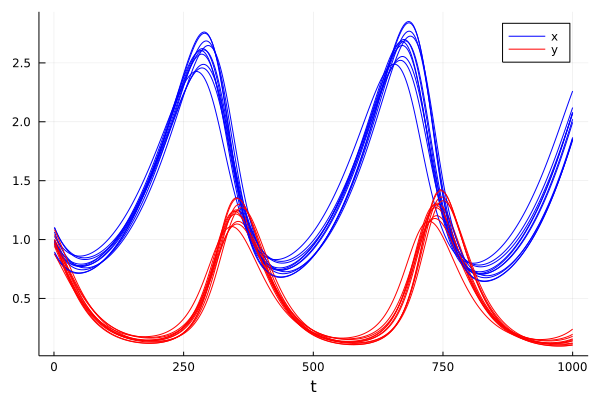
While it is very simple and universal, it may become hard to interpret.
What is the probability that it will higher than
? Improving accuracy with higher number of samples (expensive!)
Propagating a Gaussian
Propagation of uncertainty has been studied in many areas of science. Relation between accuracy and computational speed is always a tradeoff.
A common appoach to propagation of uncertainty is linearized Gaussian:
variable
is represented by gaussian transformation of addition:
transformation of multiplication:
general transformation approximated:
This can be efficienty implemented in Julia:
struct GaussNum{T<:Real}
  μ::T
  σ::T
end
import Base: +, *
+(x::GaussNum{T},a::T) where T =GaussNum(x.μ+a,x.σ)
+(a::T,x::GaussNum{T}) where T =GaussNum(x.μ+a,x.σ)
*(x::GaussNum{T},a::T) where T =GaussNum(x.μ*a,a*x.σ)
*(a::T,x::GaussNum{T}) where T =GaussNum(x.μ*a,a*x.σ)
For the ODE we need multiplication of two Gaussians. Using Taylor expansion and neglecting covariances:
which trivially applies to sum:
+(x1::GaussNum{T},x2::GaussNum{T}) where T =GaussNum(x1.μ+x2.μ,sqrt(x1.σ.^2 + x2.σ.^2))
*(x1::GaussNum{T},x2::GaussNum{T}) where T =GaussNum(x1.μ*x2.μ, sqrt(x2.μ*x1.σ.^2 + x1.μ*x2.σ.^2))
Following the principle of defining the necessary functions on the type, we can make it pass through the ODE:
it is necessary to define new initialization (functions
zero)define nice-looking constructor (
) julia±(a::T,b::T) where T<:Real =GaussNum(a,b)
GX=solve(f,[1.0±0.1,1.0±0.1],[0.1,0.2,0.3,0.2],0.1,1000)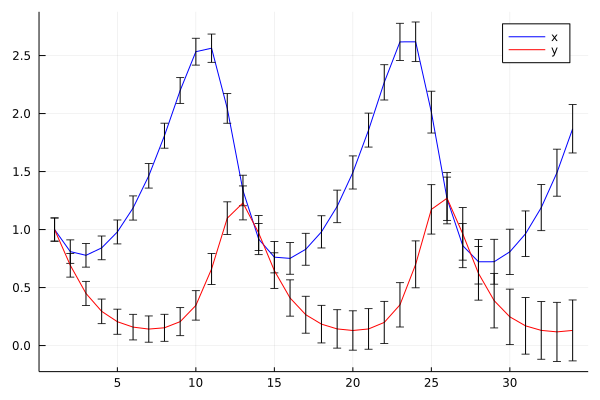
- function overloading follows a deterministic procedure => can be automated (macro, generated functions)
Flexibility
The great advantage of the former model was the ability to run an arbitrary code with uncertainty at an arbitrary number.
For example, we may know the initial conditions, but do not know the parameter value.
GX=solve(f,[1.0±0.1,1.0±0.1],[0.1±0.1,0.2,0.3,0.2],0.1,1000)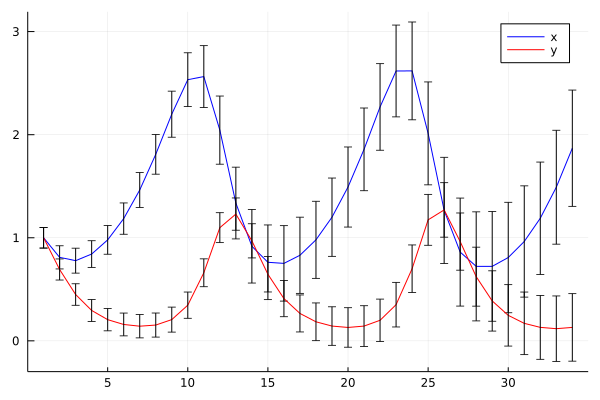
Disadvantage
The result does not correspond to the ensemble version above.
we have ignored the covariances
extension to version with covariances is possible by keeping track of the correlations (
Measurements.jl), where other variables are stored in a dictionary:correlations found by language manipulations
very flexible and easy-to-use
discovering the covariances requires to build the covariance from
ids. (Expensive if done too often).
Smarter implementation
Easiest solution is to put the corresponding parts of the problem together:
ode function
, its state
, and parameters
can be wrapped into an ODEProblem
struct ODEProblem{F,T,X<:AbstractVector,P<:AbstractVector}
    f::F
    tspan::T
    x0::X
    θ::P
end- the solver can operate on the ODEProbelm type
Vector uncertainty
The previous simple approach ignores the covariances between variables. Even if we trac covariances linearly in the same fashion (
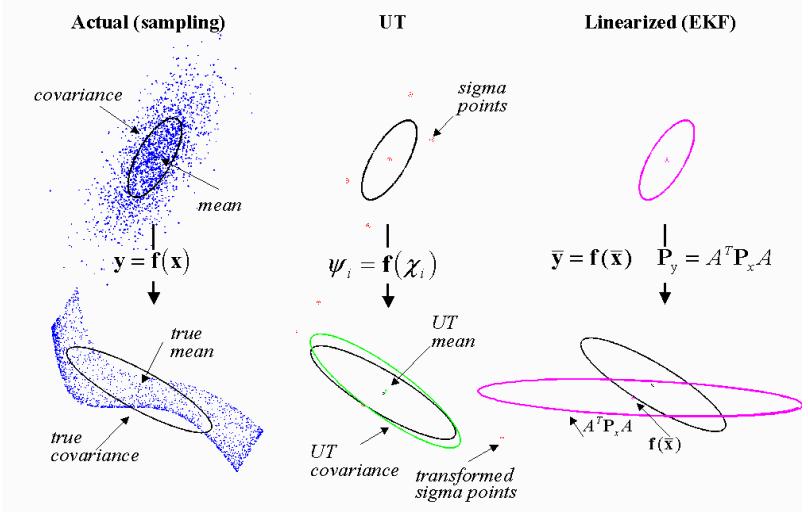
The linearization-based approach propagates through the non-linearity only the mean and models its neighborhood by a plane.
Propagating all samples is too expensive
Methods based on quadrature or cubature rules are a compromise
The cubature approach is based on moment matching:
for which is
For Gaussian distribution, we can use a smarter integration rule, called the Gauss-Hermite quadrature:
where
In multivariate setting, the same problem is typically solved with the aim to reduce the computational cost to linear complexity with dimension. Most often aimimg at
One of the most popular approaches today is based on cubature rules approximating the Gaussian in radial-spherical coordinates.
Cubature rules
Consider Gaussian distribution with mean
that can be composed into a matrix
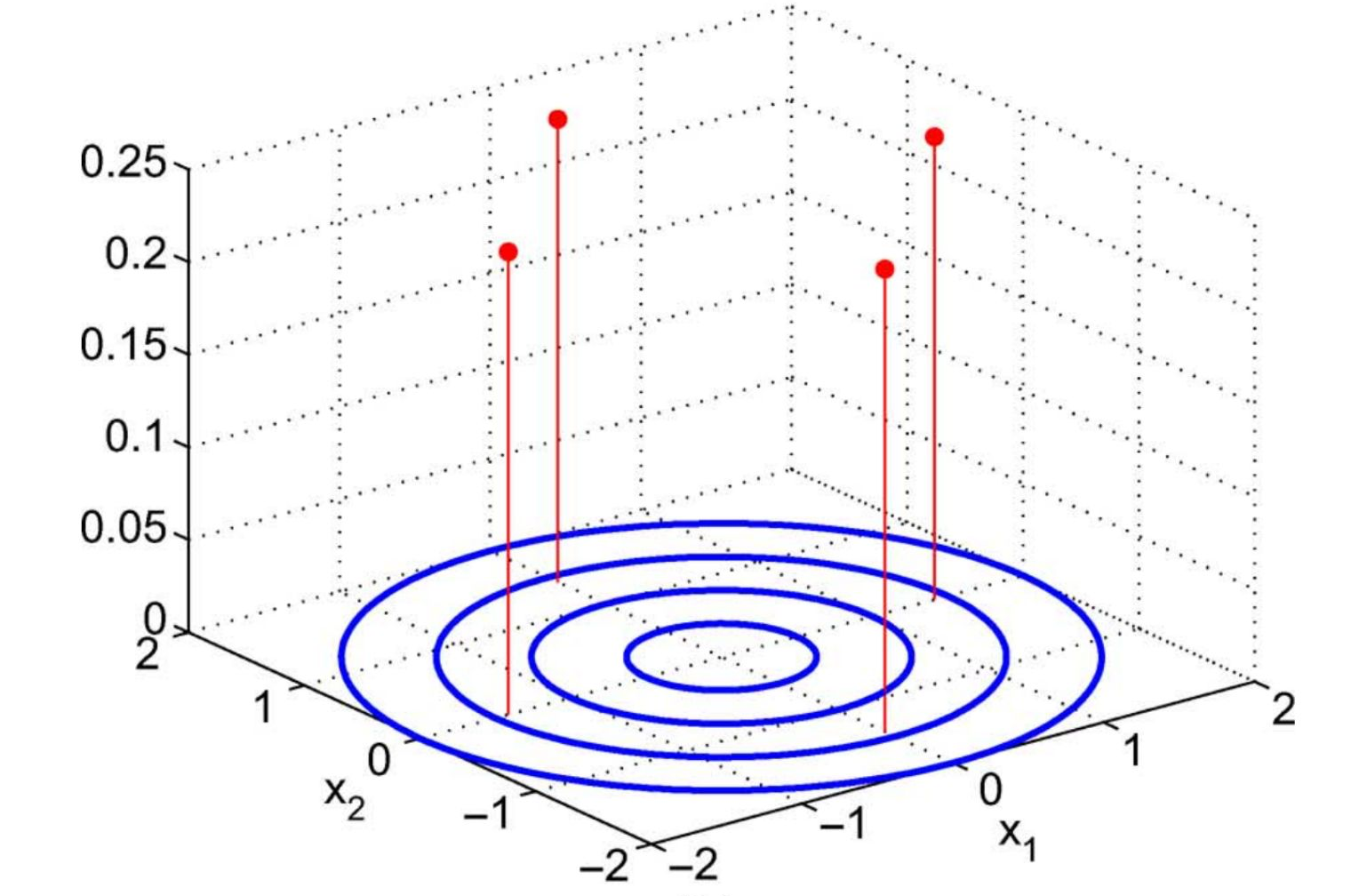
Those quadrature points are in integration weighted by:
where
The quadrature points are propogated through the non-linearity in parallel (
It is easy to check that if the sigma-points are propagated through an identity, they preserve the mean and variance.
For our example:
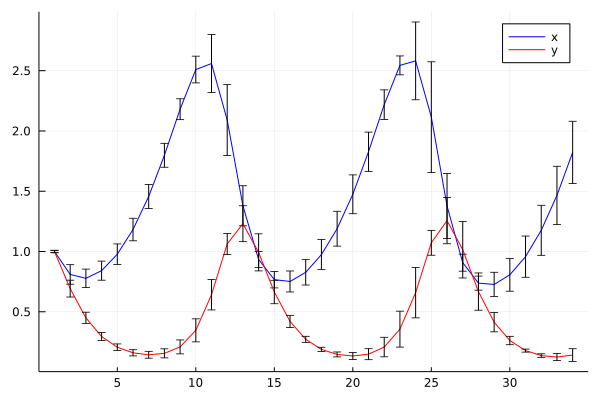
only 4 trajectories propagated deterministically
can not be implemented using a single number type
the number of points to store is proportional to the dimension
manipulation requires operations from linear algebra
moving to representations in vector form
simple for initial conditions,
how to extend to operate also on parameters?
Implementation of vector-valued uncertainty
Essentially an ensemble of ODEs where their mean values form a representation of a Gaussian distribution.
struct GaussianVector{T <: Real, V <: AbstractVector{T}, M <: AbstractMatrix{T}}
    mean::V
    covariance::M
end

# define operations on GaussianVector

# dispatch solve for GaussianVector
function solve(prob::ODEProblem{F, Tspan, X0<:GaussianVector, P}; kwargs...)
  # implemnet the solver
end