Homework 12 - The Runge-Kutta ODE Solver
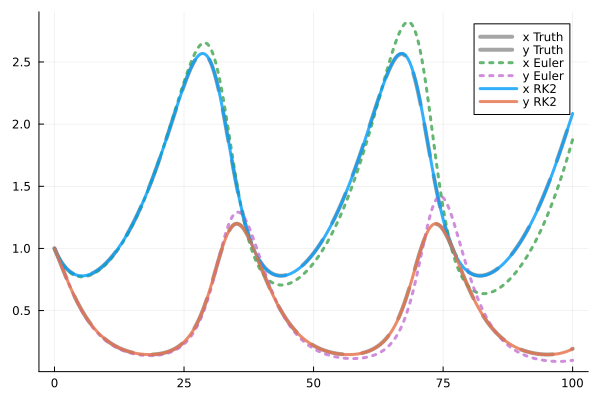
There exist many different ODE solvers. To demonstrate how we can get significantly better results with a simple update to Euler, you will implement the second order Runge-Kutta method RK2:
RK2 is a 2nd order method. It uses not only RK2 computes an initial guess 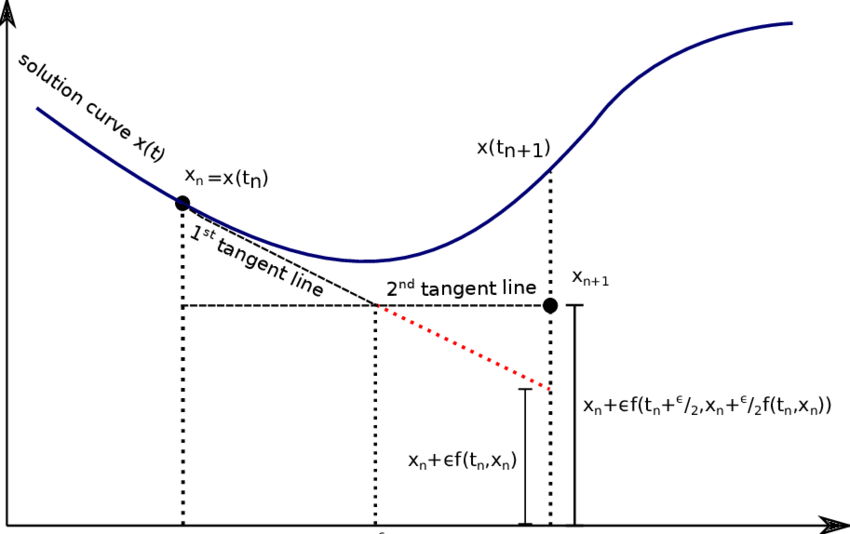
The code from the lab that you will need for this homework is given below. As always, put all your code in a file called hw.jl, zip it, and upload it to BRUTE.
struct ODEProblem{F,T<:Tuple{Number,Number},U<:AbstractVector,P<:AbstractVector}
    f::F
    tspan::T
    u0::U
    θ::P
end


abstract type ODESolver end

struct Euler{T} <: ODESolver
    dt::T
end

function (solver::Euler)(prob::ODEProblem, u, t)
    f, θ, dt  = prob.f, prob.θ, solver.dt
    (u + dt*f(u,θ), t+dt)
end


function solve(prob::ODEProblem, solver::ODESolver)
    t = prob.tspan[1]; u = prob.u0
    us = [u]; ts = [t]
    while t < prob.tspan[2]
        (u,t) = solver(prob, u, t)
        push!(us,u)
        push!(ts,t)
    end
    ts, reduce(hcat,us)
end


# Define & Solve ODE

function lotkavolterra(x,θ)
    α, β, γ, δ = θ
    x₁, x₂ = x

    dx₁ = α*x₁ - β*x₁*x₂
    dx₂ = δ*x₁*x₂ - γ*x₂

    [dx₁, dx₂]
end
lotkavolterra (generic function with 1 method)Implement the 2nd order Runge-Kutta solver according to the equations given above by overloading the call method of a new type RK2.
(solver::RK2)(prob::ODEProblem, u, t)You should be able to use it exactly like our Euler solver before:
using Plots
using JLD2

# Define ODE
function lotkavolterra(x,θ)
    α, β, γ, δ = θ
    x₁, x₂ = x

    dx₁ = α*x₁ - β*x₁*x₂
    dx₂ = δ*x₁*x₂ - γ*x₂

    [dx₁, dx₂]
end

θ = [0.1,0.2,0.3,0.2]
u0 = [1.0,1.0]
tspan = (0.,100.)
prob = ODEProblem(lotkavolterra,tspan,u0,θ)

# load correct data
true_data = load("lotkadata.jld2")

# create plot
p1 = plot(true_data["t"], true_data["u"][1,:], lw=4, ls=:dash, alpha=0.7,
          color=:gray, label="x Truth")
plot!(p1, true_data["t"], true_data["u"][2,:], lw=4, ls=:dash, alpha=0.7,
      color=:gray, label="y Truth")

# Euler solve
(t,X) = solve(prob, Euler(0.2))
plot!(p1,t,X[1,:], color=3, lw=3, alpha=0.8, label="x Euler", ls=:dot)
plot!(p1,t,X[2,:], color=4, lw=3, alpha=0.8, label="y Euler", ls=:dot)

# RK2 solve
(t,X) = solve(prob, RK2(0.2))
plot!(p1,t,X[1,:], color=1, lw=3, alpha=0.8, label="x RK2")
plot!(p1,t,X[2,:], color=2, lw=3, alpha=0.8, label="y RK2")